Open for visitorsThe installation — October 20, 2026
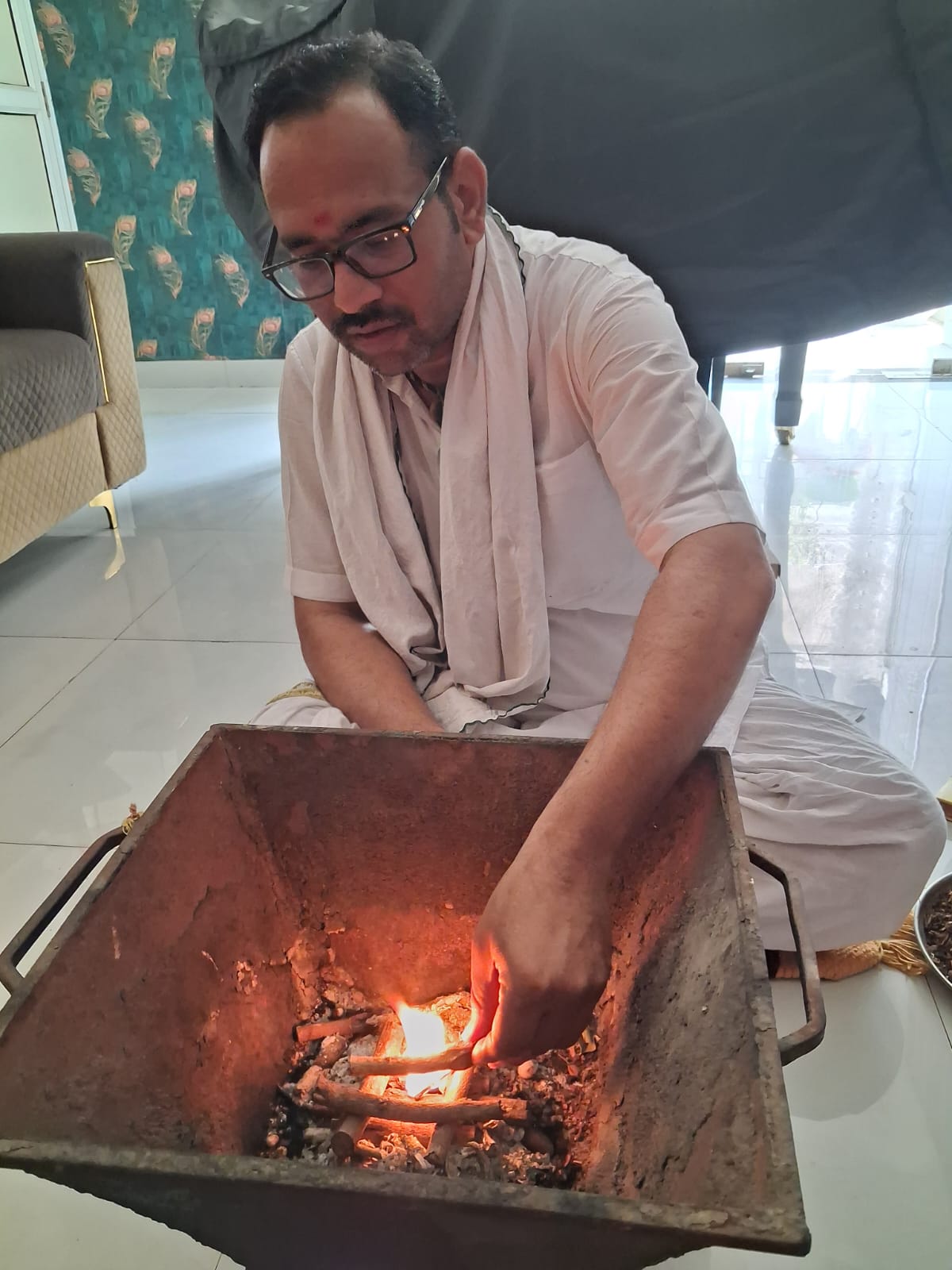
The yagya and abhishek, performed at the 2 PM Dussehra muhurta by Pandit Agnihotra.
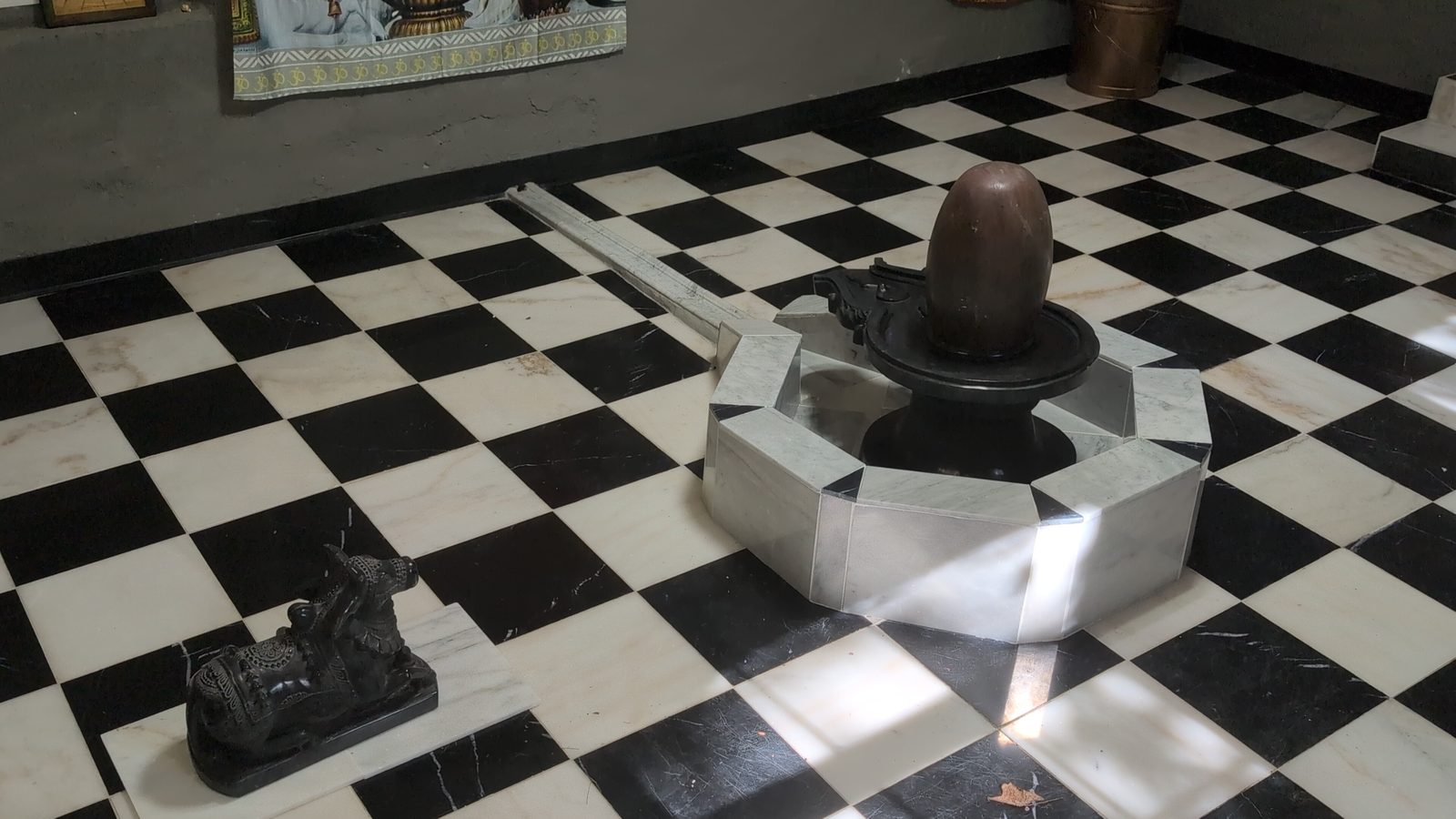
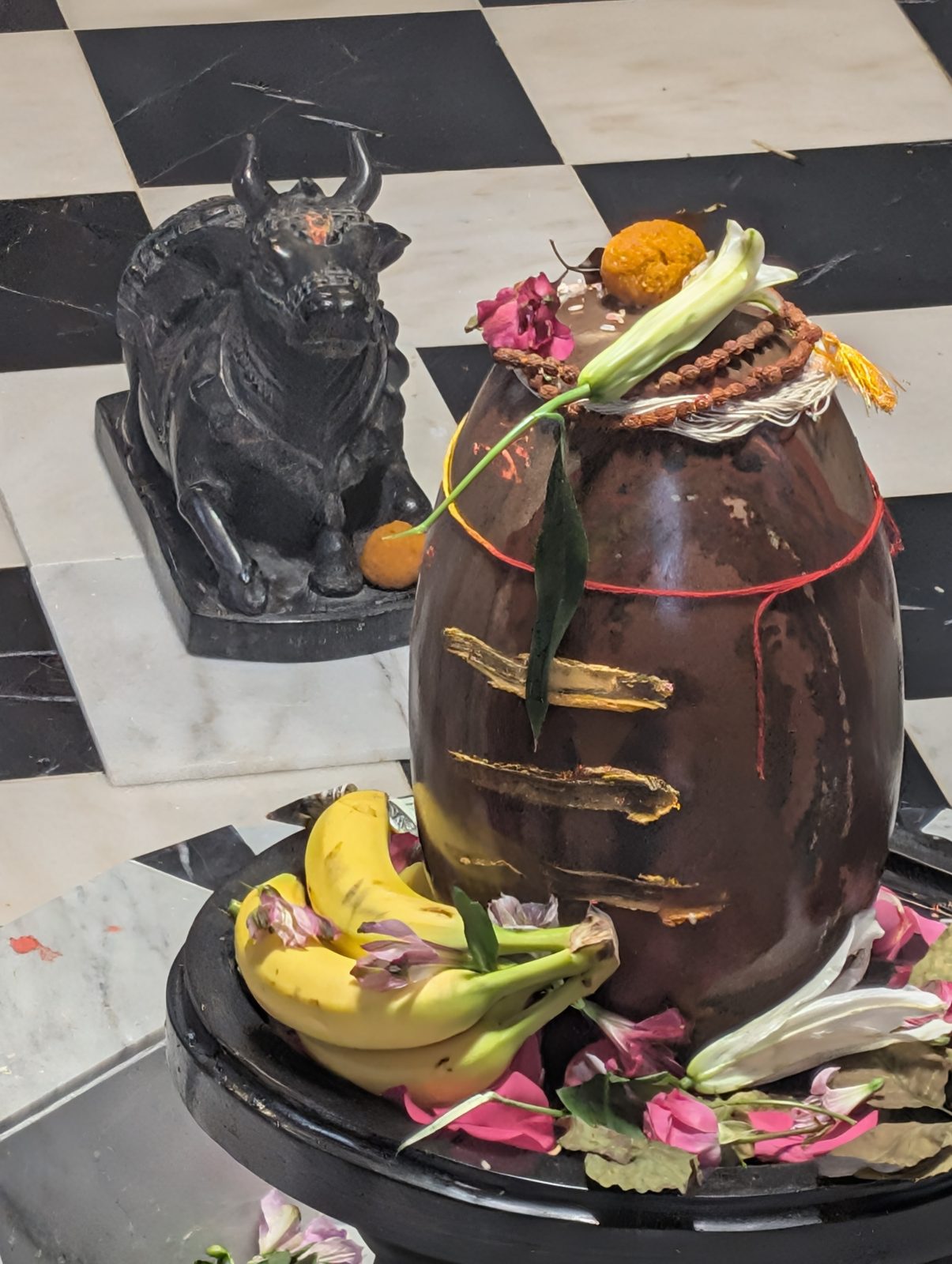
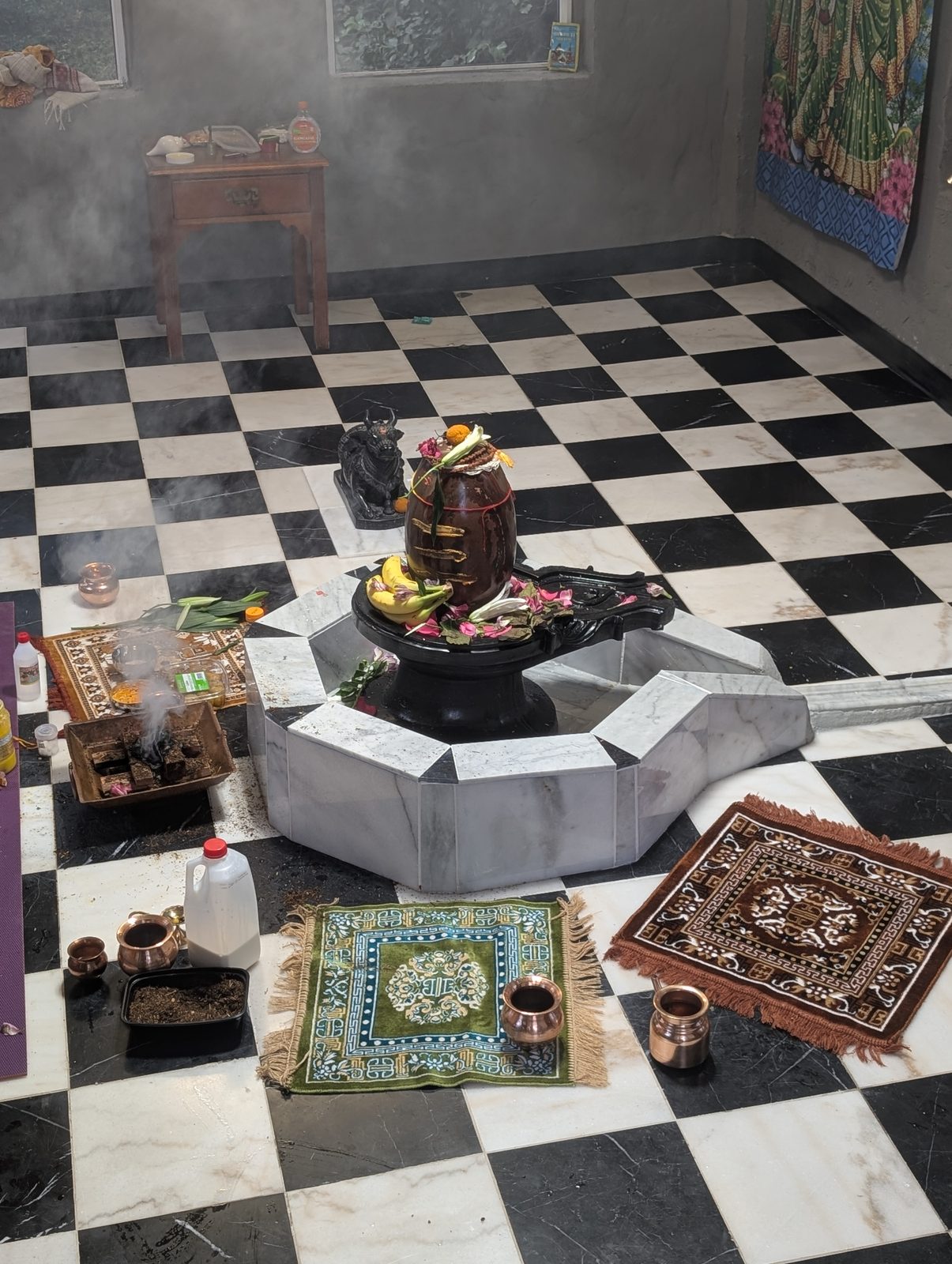
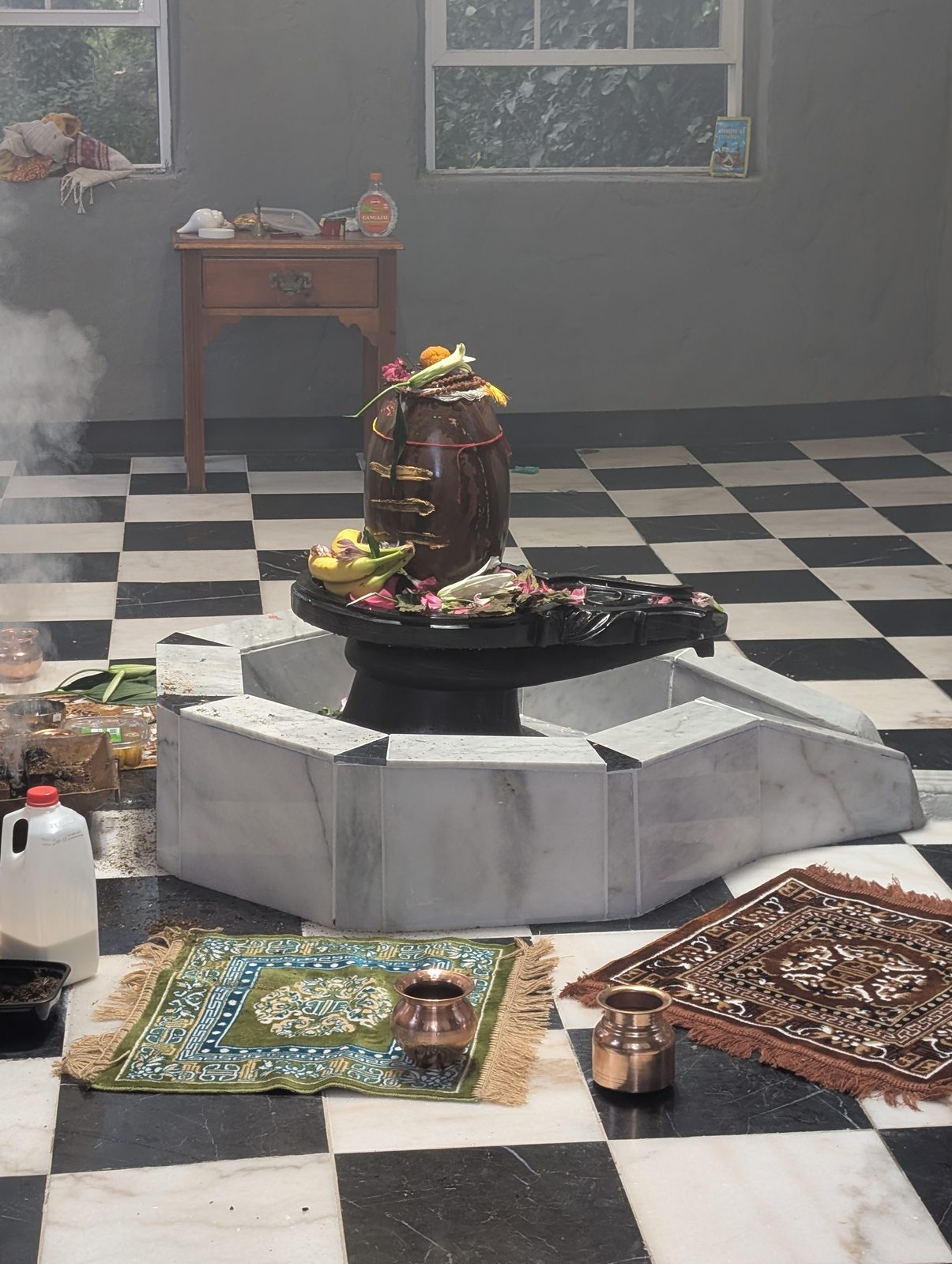
You do not need a priest to stand between you and Shiva. Pour the water yourself, take as long as you like, and say what you came to say. Everybody is welcome — no appointment, no form. Bring the wish you are carrying.
The fire ceremony (yagya) and the sacred bathing of the deity (abhishek) were performed on October 20, 2026, at the 2:00 PM Dussehra muhurta — the auspicious window on one of the holiest days of the year. Pandit Agnihotra performed the rites. With that, Gopeshwar Mahadev was installed here for the first time.
Full program coming soon. A new priest arrives next month to take up the daily worship, and the aartis and the daily rhythm start then. Until then the temple is open for visits — just not on a fixed clock. Call ahead if you're coming from far away and somebody will meet you.
The steps here lead down to Shiva. Across the tradition it is held that when you descend to meet Him rather than climb, that Shivling becomes iccha-purti — wish-fulfilling. People travel a long way for a Shiva temple built this way. There is one on Turner Road.
The Shiva stone (Shiva-lingam) installed here is a Narmadeshwar — a stone from the bed of the Narmada River in India. A Narmadeshwar is self-established (swayambhu). Nobody carved it and nobody shaped it. The river did. Those stones are tumbled, pressed, and polished smooth over thousands of years by the current of the Narmada itself.
There's a reason our tradition treats that as sacred rather than as a geological accident. In the holy books — the Shiva Purana and the Skanda Purana — the Narmada River is the daughter of Lord Shiva, and Shiva granted her a boon: every stone that comes up out of her riverbed is already a living form of Him, carrying His presence without any human ritual being needed.
That's why a Narmadeshwar does not require Prana Pratishtha — the formal Vedic ceremony that installs the breath and life of the deity into an image. It arrives already alive. A carved deity has to be invited in. This one was never anywhere else.
And there are steps leading down into this temple. The Shivling sits at a level below the ground you walk in on. There's a well-known belief across Shiva temples that when the steps go down to the Shivling — when you descend to meet Him rather than climb — that deity becomes a wish-fulfilling (iccha-purti) Shivling. People travel a long way for a Shiva temple built that way. We have one on Turner Road.
The yagya and abhishek, performed at the 2 PM Dussehra muhurta by Pandit Agnihotra.
A temple in a place you wouldn't expect. We're a small Hindu temple (mandir) opening up right here in Thomasville Heights — a Black working-class neighborhood on Atlanta's southeast side. The land is already zoned as a church, and the building is getting fixed up to be a place where you can eat free blessed food (prasadam), worship (puja), and just sit in peace. Whatever brought you here — you were curious, you were looking for God, you needed somewhere quiet — there's a seat waiting for you. Our doors open for everybody. And the food never costs a thing.
This land was not empty when we got here. The ground beneath this temple was home to the original church of Thomasville Heights, founded and led by Reverend W. H. Carter. Reverend Carter was known across the neighborhood — he fed people, he counseled people, he kept an open door, and he served this community long before that kind of service was easy or appreciated. When you walk onto this property, you are walking onto land already consecrated by his work and by the prayers of the people he gathered here.
We did not come to replace that legacy. We came to continue it. The doors that were open under Reverend Carter will still be open here. The meals that were served under Reverend Carter will still be served here — as prasadam now, but no less free, and no less an act of love.
And this temple does not stand alone. Within a short walk of this corner, Thomasville Heights is home to seven churches — a genuine spiritual community in what the outside world has too often called a difficult neighborhood. That label was never the whole story. There has always been prayer on these streets. We are honored to add one more voice to the chorus.
Here's an old, beautiful story. A long time ago, in a holy town in India called Vrindavan, Lord Krishna (God in His form as a beautiful dark-skinned young man) threw a sacred circle dance (Raas). Only the village girls — the cowherd girls (gopis) — could join. No men allowed. But Lord Shiva, the serious mountain-living holy man (ascetic) of the gods, wanted to be near Krishna so badly. He couldn't get in as a man. So you know what He did? He put on a woman's long dress (sari), turned Himself into a cowherd girl, and walked right into the dance. The other girls saw Him and said, "Come on in." He took His seat in the circle. Krishna smiled at Him.
That form of Shiva — Shiva dressed as a cowherd girl — is who we call Gopeshwar Mahadev. The name means "Lord of the Gopis." And in the original Gopeshwar temple in Vrindavan (at a famous old tree called the Vamsi Vata), the priests still dress the sacred Shiva stone (Shiva-lingam) in a woman's dress every single evening. They've been doing it like that for hundreds of years. It's one of the oldest temples in that whole city. And it tells a truth that's older than any argument you'll hear on the news today: God is not stuck in one kind of body, and love for God has nothing to do with what kind of body you came in.
This temple is named after that story, because that story is why our doors are open. If Shiva Himself — the boss of the holy mountain (Mount Kailash) — can put on a dress to get close to Krishna, then nobody who walks into this temple needs to prove they belong here.
Our temple is blessed and set up by a priest named Pandit Ramdev Agnihotra, from the Shyameshwar Mahadev Temple in Vrindavan, India. Pandit ji belongs to a long chain of teachers (parampara) — students learning from teachers, teachers learning from their teachers, going back hundreds and hundreds of years. Every fire ceremony (yagya), every sacred bath for the deity (abhishek), every life ceremony (sanskara) we do here — your baby's naming, a wedding, a house blessing, a funeral — we do it the old way, the way he learned it, the way it's written in the holy books (shastra). Atlanta is a long way from Vrindavan, but the way we pray is the same. He's the root; we're the branch.
God is Black. The holy books say it straight up — Krishna, the highest form of God, has skin the color of a dark rain cloud. Deep-dark. The color of the sky right before night. They even have a word for it: shyama. His forever love, Radha, is pale like moonlight. God is not one color. God is a love story between colors.
God is not one gender either. Here's two stories from the holy books: one time the demons tried to steal the drink of life (the nectar of immortality), and Lord Vishnu turned Himself into the most beautiful woman the universe had ever seen — Mohini — and walked right through them. Nobody could stop looking at Her. Another time, Lord Shiva wanted to be in Krishna's sacred dance, so He became a cowherd girl named Gopeshwari. The holy books write these stories plain. They're not made-up symbols, and they're not new ideas. God has worn every kind of body — every color, every gender — to get close to the people who love Him (the bhaktas).
We're a traditional temple. We follow the old holy books. And it's those same holy books that tell us a temple is for every single person — Black, brown, white; men, women, and every heart in between. We don't argue with nobody's path, and we don't check nobody at the door to see if their body's "right." This temple is a place to run to when you need to. Not a fence to get past.
This neighborhood has been through a whole lot. We're not here to change it. We're not here to push anybody out. We're here to give y'all a quiet, steady place to pray — free blessed food if you're hungry, a sacred bath ritual if you need one, and somewhere to sit when the world outside is loud.
Walk into this temple and you'll see pictures of Krishna, of Shiva, of the teachers who brought this tradition to us. What you might not see right away — but what we want you to know — is that we honor Jesus too. We don't think of Him as a rival, or as a leftover from somebody else's childhood religion. We think of Him as a pure representative of God.
This isn't something we made up to sound friendly to our neighbors. Our own teachers told us this, plainly, a long time ago.
A. C. Bhaktivedanta Swami Prabhupada — the founder of the Hare Krishna movement whose books sit in most Hindu temples in America — was asked about Jesus one day in 1977. He answered: "Just look at Jesus Christ — crucified. What was his fault? He was simply teaching God consciousness… We don't take Jesus Christ as insignificant. We give him all honor. He is a pure representative of God." He said Jesus "directed his preaching according to time, place, and circumstance" — meaning Jesus was speaking the eternal truth in a language the people around Him could actually receive.
Bhaktisiddhanta Saraswati Thakura — Prabhupada's own spiritual master, the guru who initiated him — went even further. He called Jesus jagad-guru — the spiritual teacher of the entire world. That's a heavy word in our tradition. We reserve it for the highest masters. Bhaktisiddhanta said Jesus' core teachings — love God, love your neighbor, do not kill, do not lie, serve the poor — are Vedic teachings. The Sanskrit names for those same virtues are words you'll hear in this mandir all the time: karuna (compassion), daya (mercy), ahimsa (non-violence to every living being).
So if your grandma raised you in the church — if you knew Jesus before you knew any of the names inside this room — you are not in the wrong place. You are already a devotee. That soft voice inside you that told you God is real, that told you God loves you, that told you the man on the cross was something more than a man — that voice is the same voice the Vedas have been calling atma (the soul) for thousands of years. Your grandma was right.
What we can offer is the method. Our tradition has kept, very carefully, a set of practices for getting closer to God — repeating God's names (nama-japa), sitting with a living teacher whose life shows you the path, eating blessed food, keeping the body as a clean instrument of worship. These are tools. They are not replacements for Jesus. Bhaktisiddhanta said it this way: if Jesus' teachings are not carried forward through a living line of teachers, His message — sought only in books — gets tangled up with thousands of human opinions. A book by itself can't do it. A living tradition can.
So here at Gopeshwar Mahadeva Mandir we say: come. If you love Jesus, come. If you love Krishna, come. If you love Shiva, come. If you don't know what you love yet — come anyway. The God you are looking for is the God we are worshipping. The names change with the language of each land. The face behind them does not.
There's a line often attributed to Prabhupada: "If you are already a good Christian, we have no reason to change you. Just be a better one." That is exactly our position. Love God. Serve others. Eat what is offered with gratitude. Sit with a teacher who is still alive. The Vedas and the Bible both point this way.
Some Christians in the neighborhood have asked us honestly: aren't Hindus against Jesus? What do y'all really believe?
The plain answer is no — we are not against Jesus. Quite the opposite. The biggest Hindu missionary ever to come to the United States was A. C. Bhaktivedanta Swami Prabhupada himself, the same teacher we quoted above. He started the Hare Krishna movement in New York City in 1966 and opened Hindu temples all across America in his final years. And in his own recorded words, he declared that Jesus Christ is the Son of God. His spiritual master, Bhaktisiddhanta Saraswati, went further — he said that the message of Jesus alone is sufficient for the spiritual welfare of the entire world. These are not soft compliments. They are direct, public confessions.
Now read the test the apostle John gave the early church — 1 John 4:2–3, what's often called the Johannine litmus:
"By this you know the Spirit of God: every spirit that confesses that Jesus Christ has come in the flesh is from God, and every spirit that does not confess Jesus is not from God."
By that test — the Bible's own test — the Hindu teachers who sent us to build this temple pass. They confess Jesus Christ. They declare Him the Son of God. They honor Him as a pure representative of the Father. By the same scripture our Christian neighbors read, these teachers are from God. They are not antichrists. They are brothers.
So no — we are not here to pull anybody away from Jesus. The teachers who raised this temple would be the first to tell you: hold on to Him.
If you come from the Gauḍīya line — if you chant the holy names, if your teachers trace back through Śrī Caitanya Mahāprabhu — you may still wonder why a Śiva temple carries this name, and whether it is yours. It is. Here is the short answer, in our ācāryas' own words.
The Śrīmad-Bhāgavatam (12.13.16) settles it in four words: vaiṣṇavānāṁ yathā śambhuḥ — "Lord Śambhu [Śiva] is the greatest of the Vaiṣṇavas." Not a rival to Kṛṣṇa. The foremost of His devotees.
Śrī Caitanya Mahāprabhu set the precedent Himself. Śrīla Kṛṣṇadāsa Kavirāja Gosvāmī records (Caitanya-caritāmṛta, Madhya 17.191) that when the Lord toured the holy places along the Yamunā, Bhūteśvara Mahādeva was among the places He visited. Mahāprabhu went to see Śiva in Vraja. So have His followers ever since.
In Vraja it is said plainly: one cannot enter Vṛndāvana without Gopīśvara's permission. He stands at the door. Devotees ask him for entrance — not to the town, but to the mood.
This is the part worth slowing down on. Five ācāryas across four centuries went to this same liṅga, and not one of them asked for wealth, or health, or relief from trouble. Every one of them asked for the same thing: prema — love for Rādhā and Kṛṣṇa, and service at Their feet. They asked Śiva for it. Read them in order and watch the request stay identical.
Śrīla Sanātana Gosvāmī went to see him every day. The tradition relates that when Sanātana had grown old, Gopīśvara came to him in a dream: "Now that you are old, please do not go through so much trouble to see me." Sanātana answered that he would keep coming anyway. So Gopīśvara told him, "Then I will come and stay very near to your residence" — and the next day he manifested at Bāṅkhaṇḍi, halfway between his own temple and where Sanātana lived. The deity moved closer rather than be visited less. This one is a story the Vrajavāsīs tell, carried down by our teachers rather than quoted from śāstra — we pass it on the way we received it.
Śrīla Raghunātha Dāsa Gosvāmī put his worship into writing. Śrī Vraja-vilāsa-stava, verse 87:
mudā gopendrasyātmaja-bhuja-pariṣvaṅga-nidhaye · sphurad-gopī-vṛndair yam iha bhagavantaṁ praṇayibhiḥ · bhajadbhis tair bhaktyā svam abhilaṣitaṁ prāptam acirād · yamī-tīre gopīśvaram anudinaṁ taṁ kila bhaje
"I daily worship Gopīśvara Sadāśiva, who was devotedly worshipped on the bank of the Yamunā by the loving gopīs who desired the jewel-like embrace of the arms of Śrī Kṛṣṇa, the prince of Vraja, and who thus swiftly attained their desired object."
The commentary on that verse gives the name's origin: the gopīs worshipped Śiva on the Yamunā's bank wanting Kṛṣṇa's company, they received it, "and the deity has hence become famous as Gopīśvara" — the Lord of the gopīs, named for the people who loved him and for what he gave them.
Śrīla Viśvanātha Cakravartī Ṭhākura gave the praṇāma-mantra that rūpānuga devotees still recite before him — Śrī Saṅkalpa-kalpadruma, text 103:
vṛndāvanāvani-pate jaya soma soma-maule · sanaka-sanandana-sanātana-nāradeḍya · gopīśvara vraja-vilāsi-yugāṅghri-padme · prema prayaccha nirūpādhi namo namas te
"O gatekeeper of Vṛndāvana! O Soma, all glories to you! O you whose forehead is decorated with the moon, worshipful for the sages headed by Sanaka, Sanandana, Sanātana and Nārada! O Gopīśvara! Desiring that you bestow upon me prema for the lotus feet of Śrī Rādhā-Mādhava, who perform joyous pastimes in Vraja-dhāma, I offer obeisances unto you time and again."
Śrīla Narahari Cakravartī — Bhakti-ratnākara (5.3741) — bows the same way and names the same gift:
śrīmad-gopīśvaraṁ vande śaṅkaraṁ karuṇā-mayam · sarva-kleśa-haraṁ devaṁ vṛndāraṇya-rati-pradam
"I offer my respectful obeisances to Śrī Gopīśvara, who is merciful Lord Śiva himself. He removes all troubles, and he grants loving attachment in Vṛndāvana."
Śrīla Bhaktivinoda Ṭhākura carries him out of Vraja and into Navadvīpa. At the Yogapīṭha, Kṣetrapāla Śiva — the protector of the dhāma — is eternally worshipped, and he is known there as Śrī Gopīśvara. The followers of Śrīla Rūpa Gosvāmī honor him in that form and pray to him for pure service. The same deity, the same request, a different dhāma.
So when you stand before the liṅga in this temple, you are not stepping outside your tradition — you are standing exactly where Sanātana Gosvāmī, Raghunātha Dāsa Gosvāmī, Viśvanātha Cakravartī Ṭhākura, Narahari Cakravartī and Bhaktivinoda Ṭhākura stood, asking for the one thing all five of them asked for.
The old song says it the way a crowd says it: jaya jaya gopīśvara vṛndāvana-mājh — all glories, all glories to Gopīśvara, who stands in the midst of Vṛndāvana.
He stands on Turner Road now too. Ask him for what they asked him for.
Full program coming soon. A new priest arrives next month to take up the daily worship, and the aartis and the daily rhythm start then. Until then the temple is open for visits — just not on a fixed clock. Call ahead if you're coming from far away and somebody will meet you.
| 5:30 AM | Morning lamp ceremony (Mangala Aarti) |
| 7:30 AM | Sacred bath + Shiva prayers (Rudra Path) |
| 12:00 PM | Noon lamp ceremony + free blessed food served (Raj-Bhog Aarti) |
| 7:00 PM | Evening lamp ceremony (Sandhya Aarti) |
| 8:30 PM | Bedtime lamp ceremony (Shayan Aarti) |
| Mondays, 4 PM | Big Shiva bathing ritual (Maha Rudrabhishek) |
| Saturdays, 7 PM | Group singing of the 40 verses to Hanuman (Hanuman Chalisa) |
| Sundays, 11 AM | Free community meal + short talk |
The amounts below are what we suggest, but we kept them low on purpose. This temple is a service to the neighborhood — it ain't a pay-to-pray business. If your family can't give the suggested amount, come anyway. We'll still do the ceremony. The blessed food is always free, no matter what.
| Shiva bathing ritual (Rudrabhishek) | $31 suggested |
| Healing chant for protection — 108 times (Maha Mrityunjaya Japa) | $51 suggested |
| Prayers to the Goddess (Chandi Path) | $101 suggested |
| House blessing, done at your home (Griha Pravesh) | $51 suggested |
| Baby naming ceremony (Namkaran) | $21 suggested |
| Wedding — priest, mandap setup, full rites (Vivah) | $251 suggested |
| Funeral prayers (Antyesti) | No charge |
| Free blessed food, every afternoon | Always free |
For any fire ceremony that takes setup time, please call ahead. The temple is already open for a visit with the deity (darshan) — no appointment, no form, just come on in. Once the new priest arrives next month and the daily schedule starts, you can come any time during open hours.
We need four kinds of people right now: folks who want to help out with their hands, founding donors, regular worshippers, and sponsors. Pick the one that fits you and we'll reach back out. Nobody ever needs to fill out a form just to walk in — this is only for people who want to help us build.
1895 Turner Road SE, Atlanta, Georgia 30315
gopeshwarmahadev.org
Open for visitors now, as of October 20, 2026 — come sit with the Shivling. The daily schedule starts when our new priest arrives next month. Grand opening is January 1, 2027; after that we're open every day from 5:30 AM to 9:00 PM. If you're traveling a distance, call ahead so somebody meets you.